The lab / Science explainer
Wombat poo
The corners form inside the intestine.
Wombat poo is cube-shaped because the wall of a wombat's lower intestine is stiffer in some places than others. As the gut squeezes the drying poo over several days, the stiff and soft parts move at different speeds, and that shapes four corners and flat sides. A 2021 study by Georgia Tech and the University of Tasmania found the cubes fully formed inside the last 17 per cent of the intestine. The exit is round.
Researchers found formed cubes inside the bare-nosed wombat's colon. A round exit does not stamp out the shape. The droppings have flat faces, bevelled edges and rounded corners; they are not perfect mathematical cubes.
Nobody has a square bum. A CT scan checked.
Source: Yang et al., Soft Matter (2021), abstract and sections 2.1 to 2.3.
Explore the educational illustration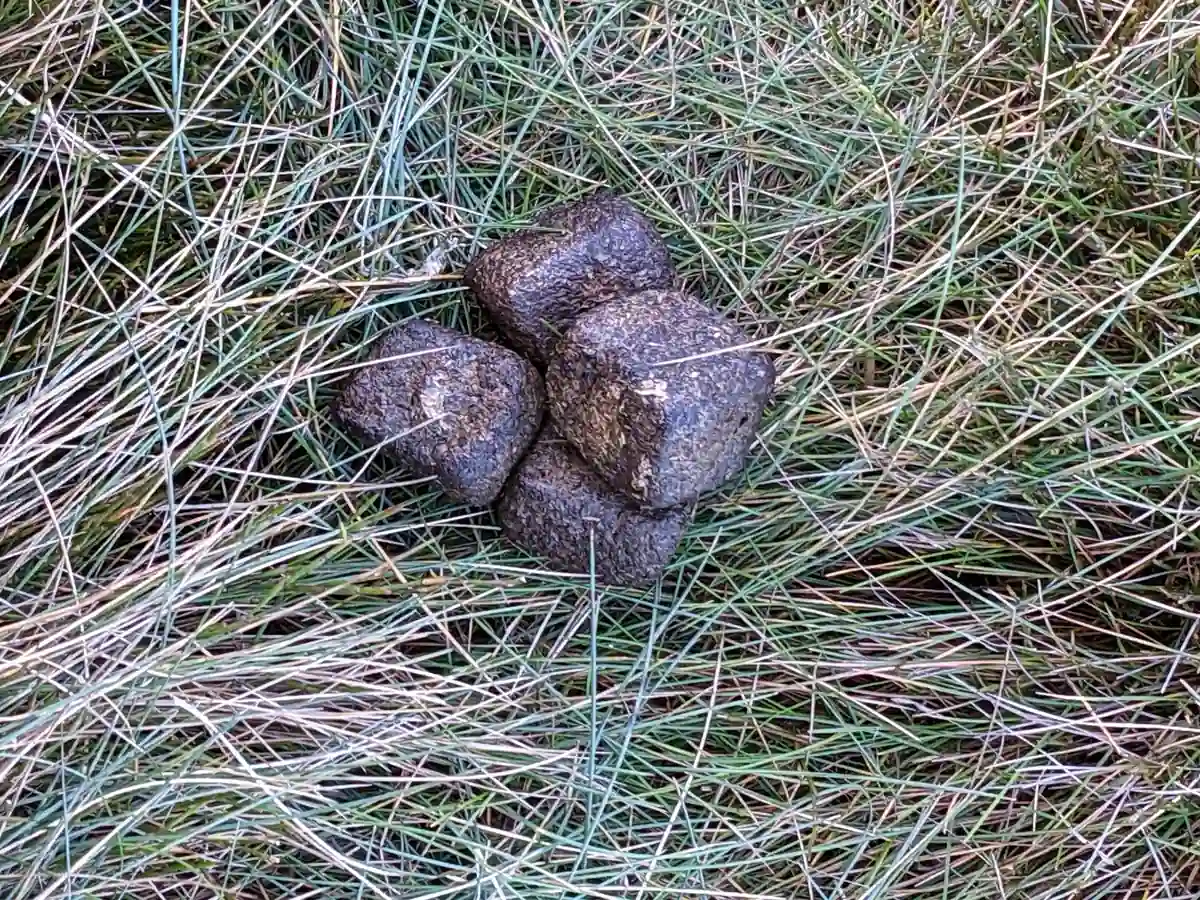

The measurements
Wombat poo in numbers
| Measure | What the research says | Source |
|---|---|---|
| Animal studied | Bare-nosed wombat (Vombatus ursinus), the most cube-like of the three wombat species. | Paper, section 1 |
| How many | 80 to 100 a day. | Paper, section 1 |
| Size | About 2.3 cm high, 2.5 cm wide and 4.0 cm long. | Paper, section 2.1 |
| Shape | Rectangular prisms with bevelled edges, ratio 1 : 1 : 1.6. | Paper, section 2.1 |
| Where the cubes form | The last 17 per cent of the intestine. | Paper, abstract |
| How dry | 53 per cent water in the last section of the gut, down from 81 per cent further up. Human poo is 74 per cent water. | Paper, section 2.1 |
| Gut wall | Some regions are about twice as thick and four times as stiff as others. | Paper, abstract |
| Intestine length | 6 to 9 m. | Paper, section 1 |
| Time food stays in the gut | 40 to 80 hours. | Paper, section 1 |
| The exit | Round, confirmed by a CT scan of a live wombat in 2019. | Paper, section 2.1 |
| Prize | Ig Nobel Prize, 2019. | University of Tasmania |
Older reports say the cubes form in the final 8 per cent of the intestine. That figure came from a 2018 conference talk (BBC, 20 November 2018). The published 2021 paper says 17 per cent.
The mechanism
How do wombats make cube-shaped poo?
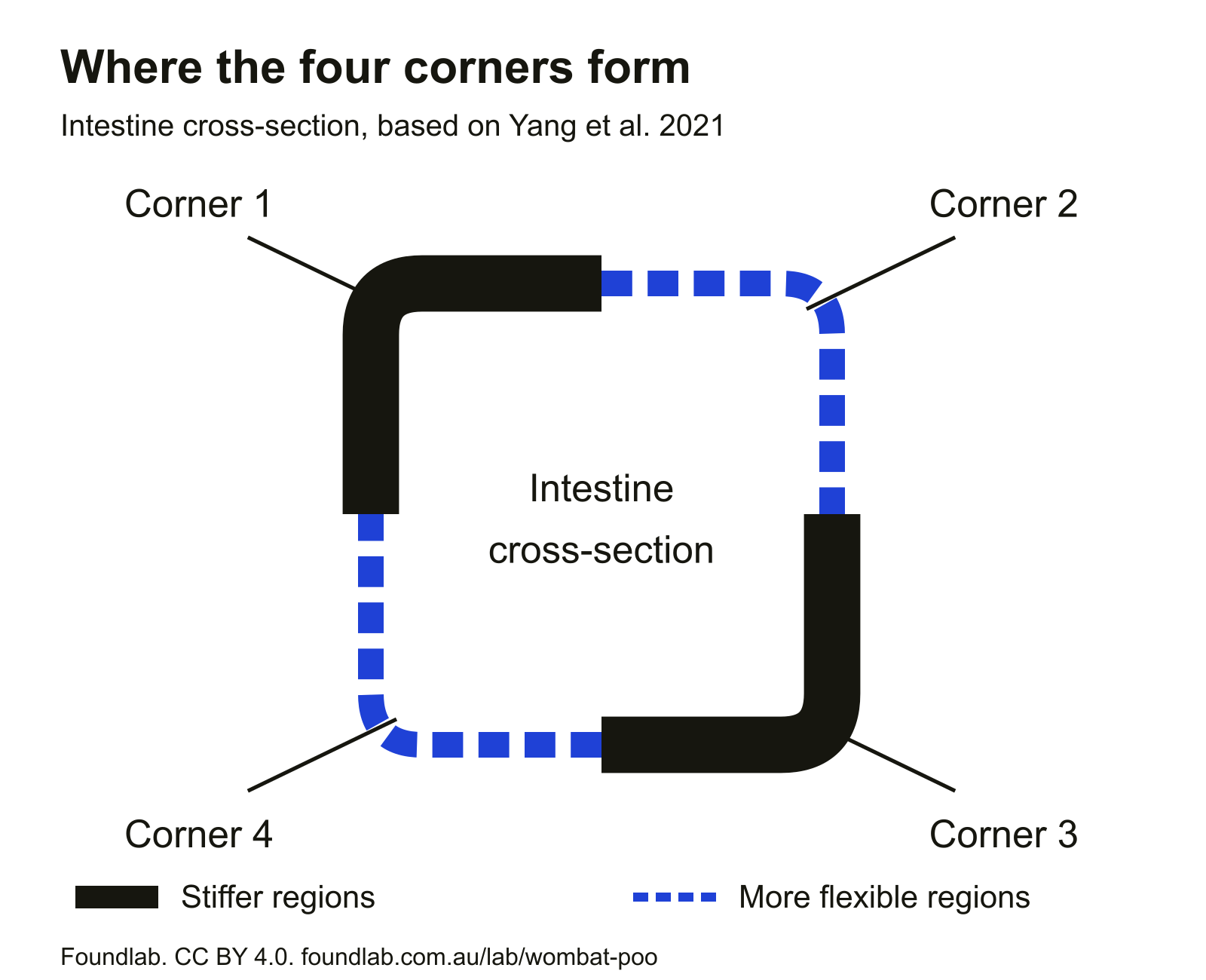
The wall moves differently around the intestine. The paper's model shows corners forming in the middle of each stiff region and in the middle of each soft region. Each flat face crosses a join.
Stiffer regions
More flexible regions
Each corner sits in the middle of a band. The flat faces cross the joins between stiff and soft bands.
A diagram to keep
Where the four corners form
Download the diagram (PNG, SVG).
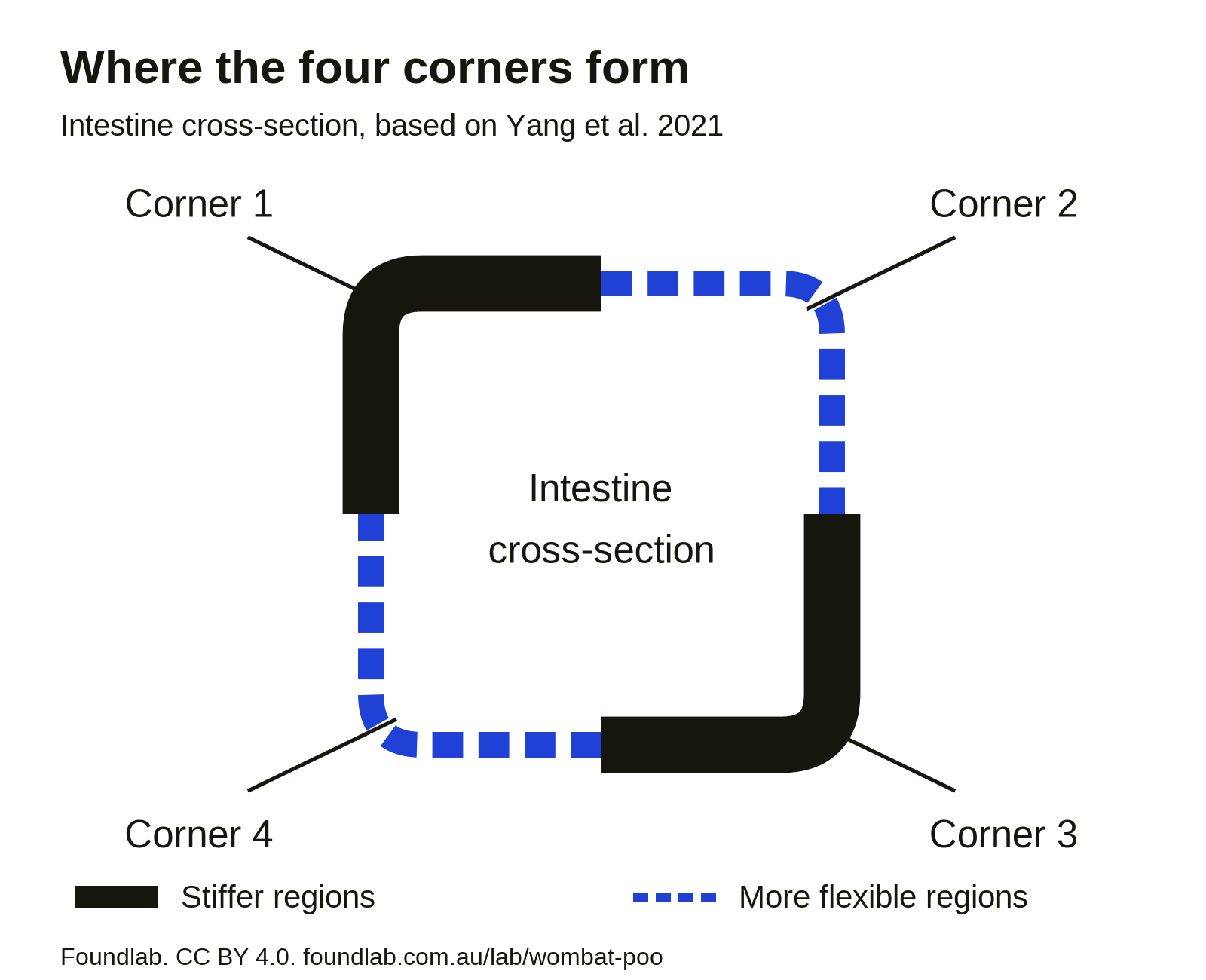
Free to reuse with credit: Foundlab, CC BY 4.0, link to this page.
Copy-paste embed snippet
<figure><img src="https://foundlab.com.au/lab/wombat-poo/wombat-poo-cube-diagram.png" alt="Diagram of a wombat intestine cross-section showing stiff and soft bands and where the four corners form" width="1600" height="1300"><figcaption><a href="https://foundlab.com.au/lab/wombat-poo">Foundlab: why wombat poo is square</a>. CC BY 4.0.</figcaption></figure>Cite this page: Dan d'Auvergne, “Wombat poo: why it is square and how the cubes form”, Foundlab, 15 November 2026. https://foundlab.com.au/lab/wombat-poo.
Watch the corners form
Schematic animation based on Yang et al. 2021. It is a drawing, with no simulation behind it.
Voiceover: synthetic voice from HeyGen.
The evidence
What the study tested
Patricia Yang and David Hu (Georgia Tech) with Scott Carver (University of Tasmania) combined dissections, tissue measurements and mathematical modelling. Their model used alternating stiff and soft regions around an elastic ring. Corners emerged during part of a contraction.
The stretch test found one stiff region. The model assumes two, because the muscle is also thicker on the opposite side.
Source: Intestines of non-uniform stiffness mold the corners of wombat feces, Soft Matter (2021), sections 2.2 and 2.3.
The open question
Why do wombats poo on rocks and logs?
Wombats leave droppings on prominent places such as rocks and logs, where scent can help them communicate. Flat sides may help the droppings stay in place.
In a first test with dough shaped like the droppings, dropped onto an 8 degree slope, the cubes stopped 20 cm closer to where they landed than balls did, on average.
That is a test of dough on a slope. It does not establish that cubes evolved to prevent rolling. More work on wombat behaviour is needed to explain their evolutionary purpose.
Sources: paper, section 3 and University of Tasmania's researcher explanation.
The short version
Quick answers
Americans call it wombat poop. Same cubes.
Technically they are rectangular prisms. Nobody searches for that.
How big is wombat poo?
The study measured droppings about 2.3 cm high, 2.5 cm wide and 4.0 cm long.
How many poos does a wombat do a day?
Bare-nosed wombats typically produce 80 to 100 a day, mostly above ground.
Is wombat poo really a cube?
The measured droppings are rectangular prisms with bevelled edges, rather than perfect cubes. Their proportions are about 1 : 1 : 1.6.
Does wombat poo come out square?
Yes. The corners form inside the last part of the intestine, before the poo passes through a round exit.
Do all wombats do square poo?
The paper says the bare-nosed wombat makes the most cube-like poo of the three wombat species.
What do wombats eat?
Their diet mainly consists of grasses and sedges.
About this page
Why is an SEO agency writing about wombat poo?
The internet is full of shit. We decided to rank some.
I run Foundlab, a Sydney findability agency. This page is a public test. Can a one-person Sydney agency get a science explainer onto page one of Google for wombat poo, and one day above Wikipedia? I did not conduct the wombat research. There is no ranking result to announce.
Read the experiment log and operating rules.
For work with actual results, read these existing case studies:
Sources and credits
Read the original research
- Yang and colleagues, Soft Matter (2021): original paper. The mechanism, measurements and model assumptions.
- University of Tasmania: scientists get to the bottom of wombat cubed poo mystery, 28 January 2021. Researcher explanation and the unresolved question of function.
- Photograph: SojournerRL, CC0. Original photograph taken in 2021. Adaptation: crop, orientation correction and WebP compression. Diagram and animation: Foundlab, CC BY 4.0.
Source: original paper, University of Tasmania and Wikimedia Commons. Research and asset licence checked .